Don't look for the moral yet. Look for what repeats.
What connects the earlier and later stories most directly?
Genesis 27
Jacob, the younger, stands in the older brother's place.
⟷
Genesis 29
Leah, the older, is given in the younger sister's place.
Hear the echoes
Tap any Hebrew word to see what it means and how it is built.
The firstbornGenesis 27:19 · 29:26
⟷
Jacob claimed the firstborn's title. Laban's excuse turns on the same word.
DeceitGenesis 27:35 · 29:25
⟷
Isaac told Esau, “Your brother came with deceit.” Now Jacob's own complaint is built from that same root.
Eyes that cannot seeGenesis 27:1 · 29:17 · 29:23
⟷
Jacob once counted on a father who couldn't see. Now it is evening, and Jacob is the one who cannot see.
The ones who arrange itGenesis 24:29 · 27:15 · 29:23
Rebekah dresses her younger son in her older son's clothes. Laban brings his older daughter in place of the younger. Rebekah and Laban are sister and brother.
03 Explore
The story has turned around.
The same text can be read on more than one level. Choose a layer to open it.
One more echo, further on. Jacob used young goats and his brother's clothing to fool his father (Genesis 27:9, 15–16). Years later his own sons dip Joseph's coat in a young goat's blood and bring it to their father (Genesis 37:31–32).
04 Discern
Where did that detail come from?
A rabbinic tradition says Leah heard people say that the older daughter would marry the older son and the younger daughter the younger son, and that she wept over it until her eyes grew weak.
A source check
“Leah expected to marry Esau.”
How should a careful reader label that claim?
Another layer: Bereshit Rabbah 70:19 imagines the morning after. Jacob calls Leah a deceiver, daughter of a deceiver. She answers, Is there a barber without apprentices? Didn't your father call you Esau, and you answered him? This is midrash, a rabbinic retelling, not words recorded in Genesis. But it says out loud what the text lets us hear.
05 Remember
Everyone in this story struggles to see. One sees clearly.
Isaac's eyes are dim. Jacob is fooled in the dark. Leah's eyes are tender. Then the text says something about God's eyes.
Genesis 29:31
וַיַּרְא ה׳ כִּי־שְׂנוּאָה לֵאָה
“The LORD saw that Leah was unloved.”
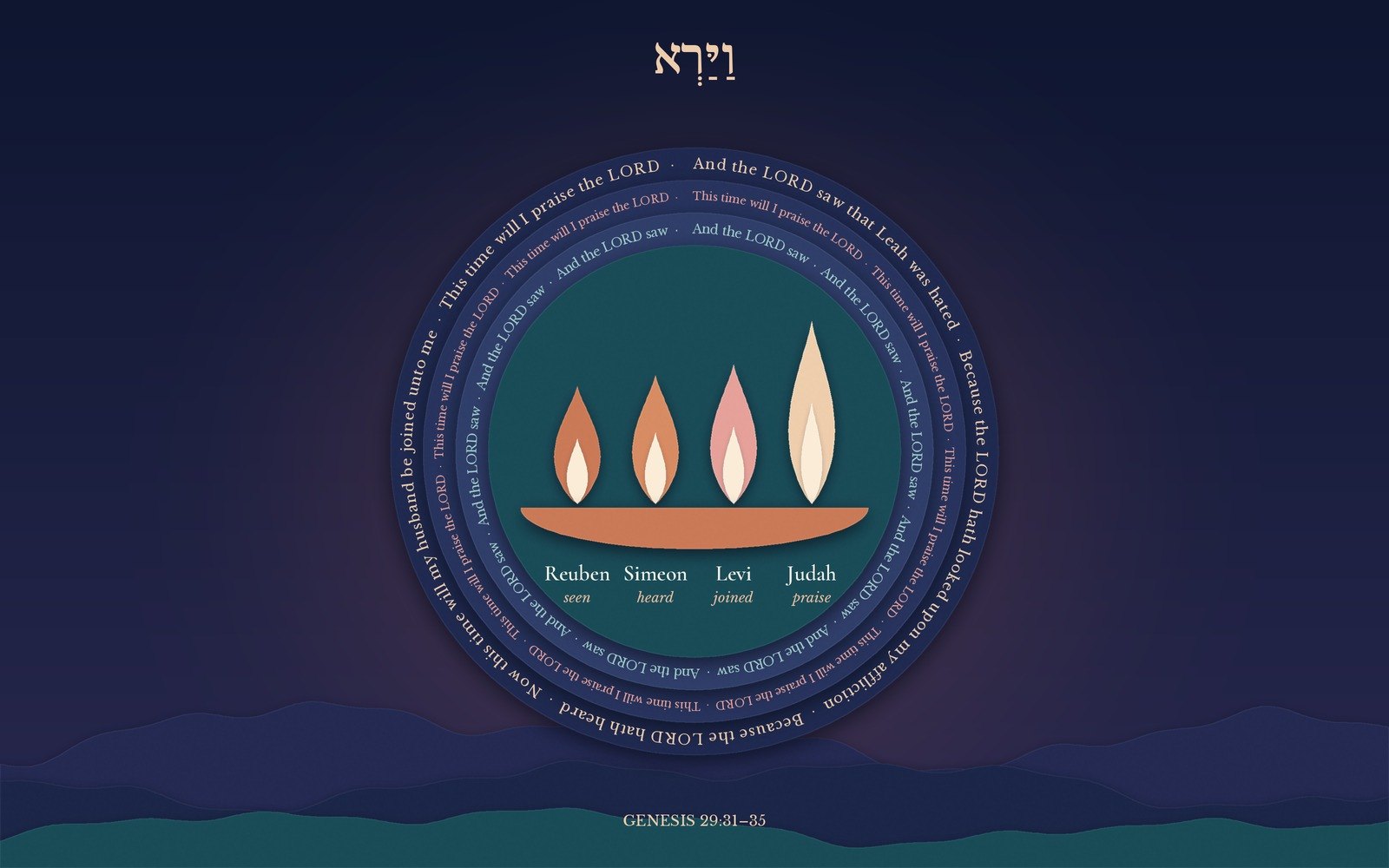
Leah names four sons, and each name is a prayer. Tap each one.
Did you notice the turn? The first three names still look toward Jacob's love. The fourth looks only up. The Talmud says that from the day the world was created, no one thanked God until Leah did, with this name (Berakhot 7b). From Levi came Israel's priests. From Judah came David's royal line. And at the end of his life, Jacob asks to be buried in the cave where he buried Leah (Genesis 49:29–31).
Which thought will you carry into this week?
30-second recall
Without scrolling up: in Genesis 29:26, which two positions does Laban contrast?
For tomorrow
What sentence came back?
Before you open the text tomorrow, try to recall the word Laban used. Then check Genesis 27:19 and 29:26 and see whether you were right.
If you study on your own, you are in good company. Leah named her sons where no one seemed to be listening, and Someone was.